



if, else, elif

Published by
sanya sanya
Introduction:
In Python, decision-making is a fundamental aspect of programming. To control the flow of a program based on certain conditions, we utilize if, else, and elif statements. These conditional statements allow us to execute specific blocks of code selectively, enabling dynamic behavior in our programs. In this comprehensive blog post, we will delve into if, else, and elif statements, provide well-explained examples, and explore their various applications.
**The if Statement:**

The if statement is the basic building block of conditional execution in Python. It allows us to execute a block of code only if a specified condition is true. The syntax of the if statement is as follows:
**Example 1:**
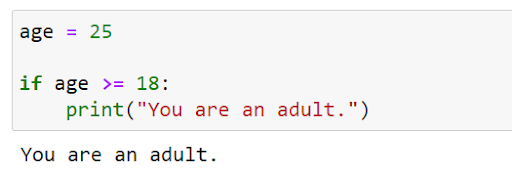
In this example, the code within the if block will execute if the condition `age >= 18` is true. Since `age` is `25` (greater than or equal to `18`), the message "You are an adult" will be printed.
**Example 2:**
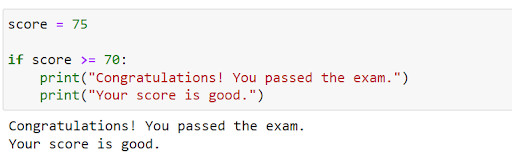
Here, the code within the if block will execute if the condition score >= 70 is true. As the score is 75, both print statements will be executed.
The else Statement:

The else statement follows an if statement and provides an alternative block of code to execute when the if condition is false. It allows us to handle the "else" case. The syntax is as follows:
**Example 1:**
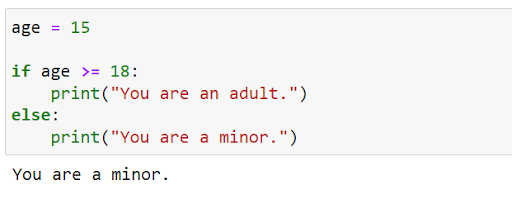
In this example, if the condition `age >= 18` is false (which it is since `age` is `15`), the else block will be executed, printing "You are a minor."
**Example 2:**
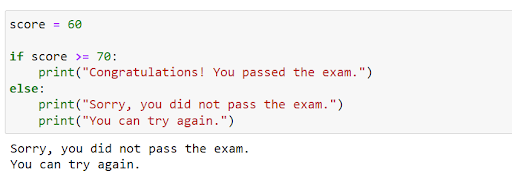
Here, if the condition `score >= 70` is false (as the `score` is `60`), the else block will be executed, printing both statements within it.
# The elif Statement:
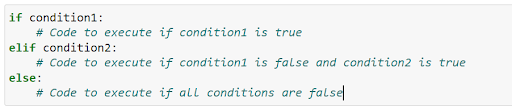
The elif statement allows us to handle multiple conditions sequentially. It follows an if statement and provides an additional condition to evaluate if the if condition is false. The syntax is as follows:
**Example 1:**
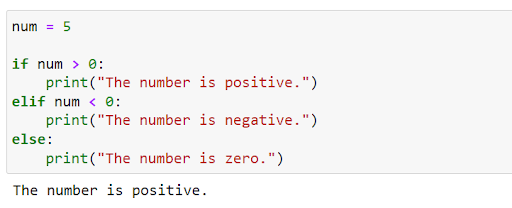
In this example, if `num` is greater than `0`, the first condition is true, and the corresponding block of code will execute. If the first condition is false, but `num` is less than `0`, the second condition will be evaluated. If both conditions are false, the else block will be executed, printing "The number is zero."
**Example 2:**
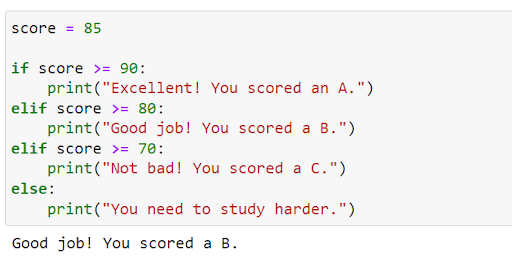
In this example, the score is `85`, which satisfies the condition `score >= 80`. Therefore, the corresponding block of code will execute, printing "Good job! You scored a B."
# Conclusion:
In Python, if, else, and elif statements provide powerful tools for decision-making and conditional execution. By utilizing these statements, we can create programs that respond dynamically to different conditions and perform specific actions based on those conditions. In this detailed blog post, we explored the syntax and functionality of if, else, and elif statements through well-explained examples.
Remember, mastering decision-making in Python is crucial for creating robust and flexible programs. By combining these conditional statements with logical operators and other programming constructs, you can build sophisticated applications that cater to various scenarios and user inputs.
Practice writing and experimenting with if, else, and elif statements in different situations to solidify your understanding. With these skills in your programming arsenal, you'll be equipped to tackle complex problems and develop efficient, intelligent solutions in Python.
Library
WEB DEVELOPMENT
FAANG QUESTIONS
On this page
Introduction:
The else Statement: